

The Anti-Churn Secrets Behind the Ladder App
By injecting some serious behavior science into their app, the Ladder app has drastically reduced churn across the board.
Nov 14, 2024
The Ladder app reduces churn by using behavior science, making it mentally painful to leave, fun to stay, and rewarding through dopamine hits. Discover how they keep users engaged and loyal in a highly competitive market.
By injecting serious behavior science into their product, the Ladder app has drastically reduced churn.
For the past 3 months, I've paid $29.99/mo for a workout app called Ladder that provides me with fool-proof workouts, 5 days a week. It's great app, user-friendly, and I love it.
I also gained seven pounds since the beginning of June (BBQ cookies are undefeated), which led me to start asking very normal human questions:
Do I really need this app?
I’m not working out as much as last month…
It’s summer. I’m busy.
Maybe I’ll cancel and come back later.
If you’re a marketer, you know exactly where this usually goes.
Churn, Baby, Churn
Churn is one of the biggest problems in the app world.

According to global retention research:
Average Day 1 retention across mobile apps: 25.3%
By Day 30: 5.7%
That’s brutal.
And what makes it worse is that churn often has nothing to do with product quality.
In Ladder’s case:
The product works
The brand is solid
Customers are happy at purchase
Yet many users still leave weeks—or even days—later.
I didn’t.
I did something stranger.
I upgraded to their most expensive plan.
And there’s very real psychology behind why.
The Anti-Churn Secrets of the Ladder App
Ladder operates in a category that’s notoriously high-churn. People will always choose cookies over compound movements eventually 😅
Instead of fighting that reality, Ladder designed their product around human behavior.
Here’s how they do it.
STEP ONE: They've made it psychologically painful to leave.
Ladder doesn’t trap you with dark UX patterns or force you to call a human (thank god).
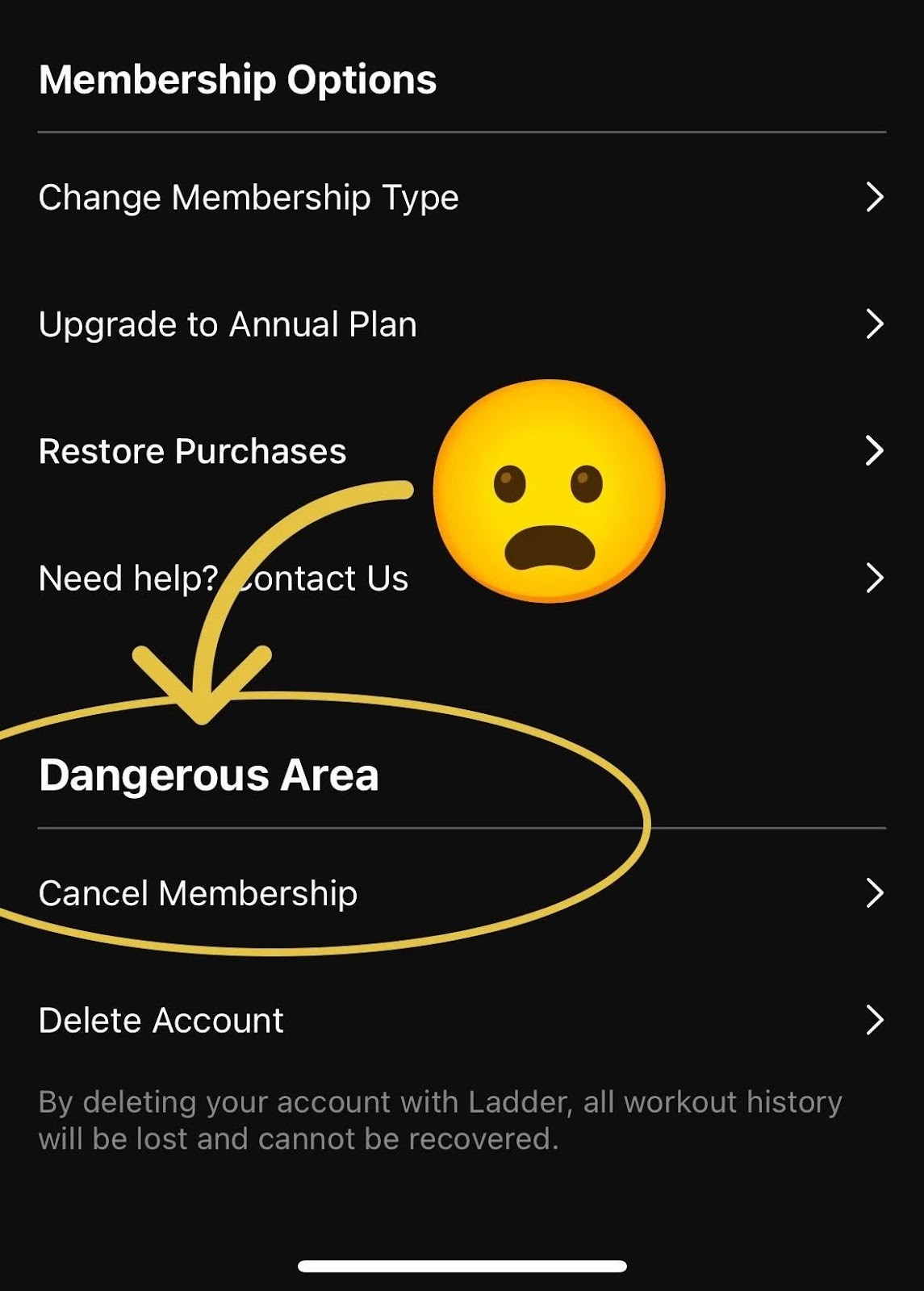
Instead, they introduce a perfectly placed “Danger Zone.”
This is a masterful use of:
Association (danger zones = bad outcomes)
Availability Heuristic (the brain recalls vivid negative experiences more easily than neutral ones)
When you approach cancellation, the interface subtly triggers anxiety. Your brain starts surfacing images of:
Losing progress
Falling off track
“Failing” again
Nothing explicit needs to be said.
The discomfort does the work.
STEP TWO: They made it psychologically fun to stay.
Ladder assigns every user a coach (leveraging Authority Proof), which many apps do.
But here’s the differentiator:
They also assign you to a team.
Each week, teams compete against each other by logging workouts. Points stack up. Rankings shift.

This taps directly into:
Competitiveness
Social identity
An irresistible us-versus-them dynamic
More workouts → better results
Better results → more motivation
More motivation → more app usage
Then they layer in rewards (like swag for top teams), which reinforces the loop.
App use → app use → app use.
It’s elegant. And dangerous (in a good way).
STEP THREE: They've engineered their app to provide massive amounts of dopamine.
Ladder’s most addictive feature might be the simplest one.
After a workout, you can send someone a “cheer.”
This triggers:
A rain shower of emojis (👏 🔥 🦍 🌶️) on their profile
And a matching emoji explosion on your screen
This is pure dopamine design.
Dopamine is a motivation neurotransmitter. It doesn’t just feel good—it makes you want more of the behavior that triggered it.
I now send emoji rain showers even when I’m not working out 😂
It’s especially powerful for users who crave encouragement and social reinforcement. Give support → receive support → come back to check.

This is a brilliant feature, especially for the audience who looks for moral support during their workouts. The more support you give, the more you get, and the more you'll return to the app to see if someone sent you a high-five shower today.

Why This Works
Ladder doesn’t fight human nature.
They design with it.
They:
Attach pain to leaving
Attach pleasure to staying
Reinforce identity through community, competition, and recognition
That’s how you reduce churn in a category that should be impossible to retain.
How to Reduce Churn Using Psychology
If you want to borrow from Ladder’s playbook:
Make it mentally painful to leave
Not physically painful. Psychologically painful. Associate churn with loss, regression, or discomfort—without manipulation.
Make it mentally satisfying to stay
Identify the emotions customers feel when using your product and amplify them. Competition. Belonging. Progress. Recognition.
Inject dopamine into interaction
Small rewards go a long way: emojis, notes, videos, acknowledgments. Dopamine keeps people coming back.
TL;DR
Customers don’t churn because products stop working.
They churn when the product stops supporting who they want to be.
Ladder succeeds because it protects identity, reinforces progress, and makes quitting feel like a step backward: not a neutral choice.
This is exactly the type of pattern CIM is designed to surface. CIM maps emotional drivers, identity threats, and motivational loops so brands can understand why customers stay—and design experiences that make churn psychologically unlikely.
Subscribe to our newsletter and stay 3 steps ahead of the competition
Learn the psychology of marketing + get weekly consumer trends (that are making real money) delivered right to your inbox every Thursday.
"I tested one trend Sarah posted...it spent $30K so far at a 2X ROAS." - A.E.

The proven system behind high performing ad teams. Join today.